
“High Magic”/“Magic High”: Financing and Conceiving The Grateful Dead Movie

(The documents described below are included among the Steve Brown Papers. MS 338, box 3, folder 2 (“Steve Brown Papers G.D. Movie: Planning”), Special Collections and Archives, University Library, University of California, Santa Cruz.)
The Grateful Dead Movie opened in select theaters across the United States in the summer of 1977. Filmed during a run of concerts at the Winterland Arena in San Francisco in October 1974, The Grateful Dead Movie features numerous musical performances, interviews with fans and members of the band and their crew, along with a remarkable animated sequence produced by Gary Gutierrez. At the time of the original performances, the fifth and final concert on October 20 was promoted as “The Last One.” (Indeed, following the last concert, the Grateful Dead took an extended hiatus from touring and would not return to the road until June 1976.) In the weeks leading up to the first concert on October 16, the band and their management worked quickly to prepare for the upcoming performances and for the thousands of Dead Heads and large film crew that would soon be arriving at the Winterland to experience and document the band’s farewell (?) concerts.
Of course, such an undertaking would require a significant amount of money. On October 3, 1974, Ron Rakow, the president of Grateful Dead Records, sent a letter to James Dollard, the assistant vice president of the First National Bank of Boston. The previous year, Dollard had approved a loan to Rakow and the Dead to finance a group of independent distributors who would be responsible for distributing albums that were to be produced and released by the Dead’s new record company. A few months after the release of From the Mars Hotel, Rakow wrote to Dollard once again inquiring about an additional loan for a new project that he and the band were planning to produce.
As seen in Figure 1, Rakow’s letter described the “proposed filming of what may be the last Grateful Dead concert (certainly for a while).” Rakow continued, noting that “in the past we have been offered substantial sums of money for doing such a project,” including an “opening offer of $175,000” from a “minor movie mogul by the name of Don Rugoff.” At the time, Rugoff owned and operated Cinema 5, an influential film distribution company and renowned theater chain in New York City. Rakow also boasted of having met “Mr. Henry Plitt of the Plitt Theater Corporation” who, like Rugoff, also “exhibited an incredible interest in this project.” Plitt, the former president of ABC Films Syndication, owned numerous theaters that had previously been controlled by Paramount Pictures including, Rakow noted, “several dozen [that] are equipped with the sound systems necessary to exhibit a feature of this type.”
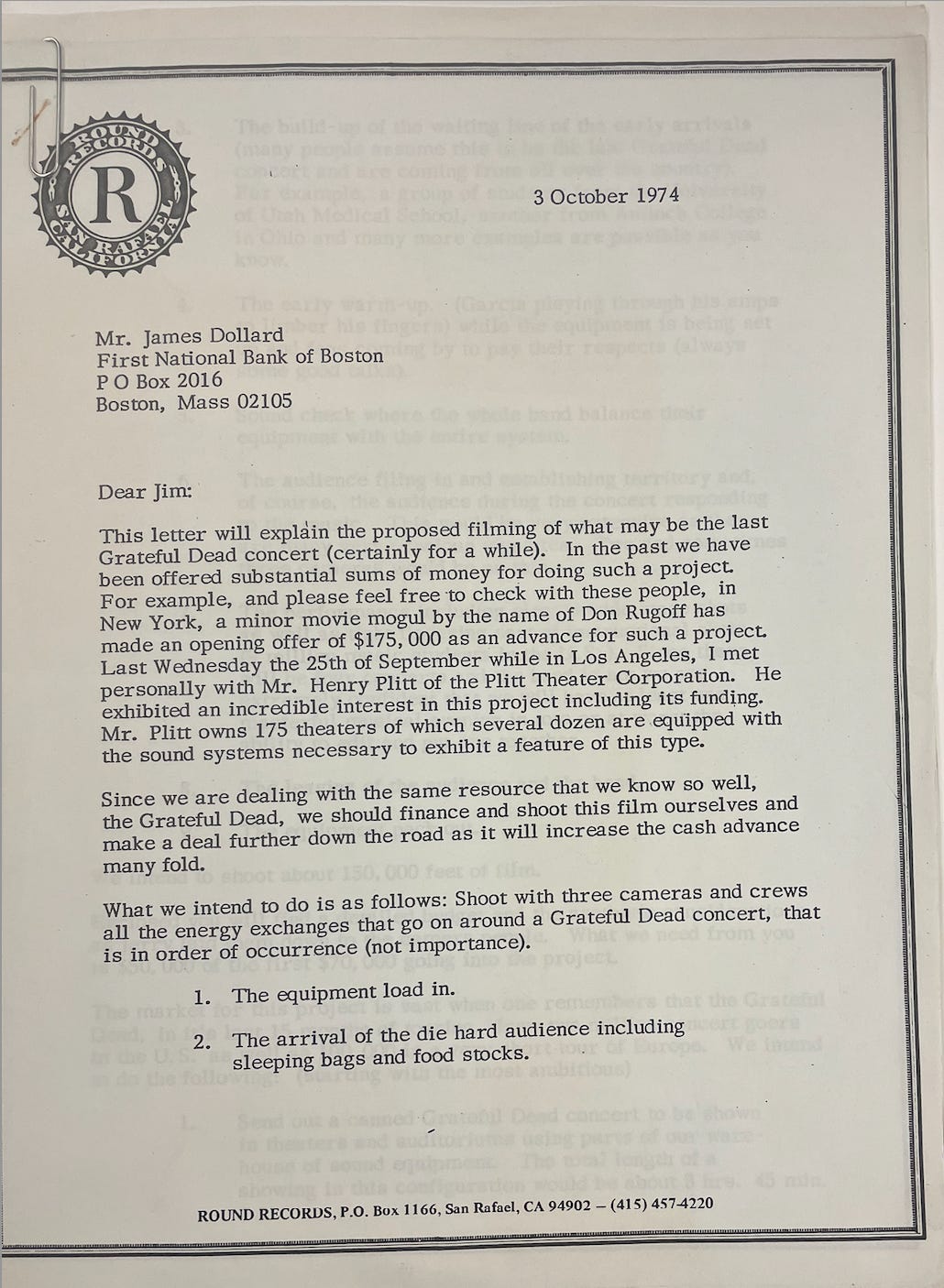
Figure 1: Page one of a letter dated October 3, 1974 from Ron Rakow to James Dollard requesting a loan for a proposed Grateful Dead concert film
Seeking to capture “all the energy exchanges that go on around a Grateful Dead concert,” Rakow provided a preliminary outline for the proposed film, beginning with “equipment load in” followed by “the arrival of the die hard audience” and other “early arrivals…from all over the country.” As seen on the second page of Rakow’s letter (reproduced below), the film would also include footage of the band and their crew backstage and during soundcheck along with extensive interviews and images of the Dead Heads. Rakow describes that the filmed musical performances would include “elegant wide stage shots as well as tight fingering sort of instructional shots” (working hard to sell the project, Rakow remarked to Dollard that there are “9 million music students in the U.S.”). Regarding the musical performances, Rakow assured Dollard that “since there will be four concerts and the band is hot we are extremely confident that we will have at least one masterful musical evening in toto or at worst the ability to edit and put one together.”
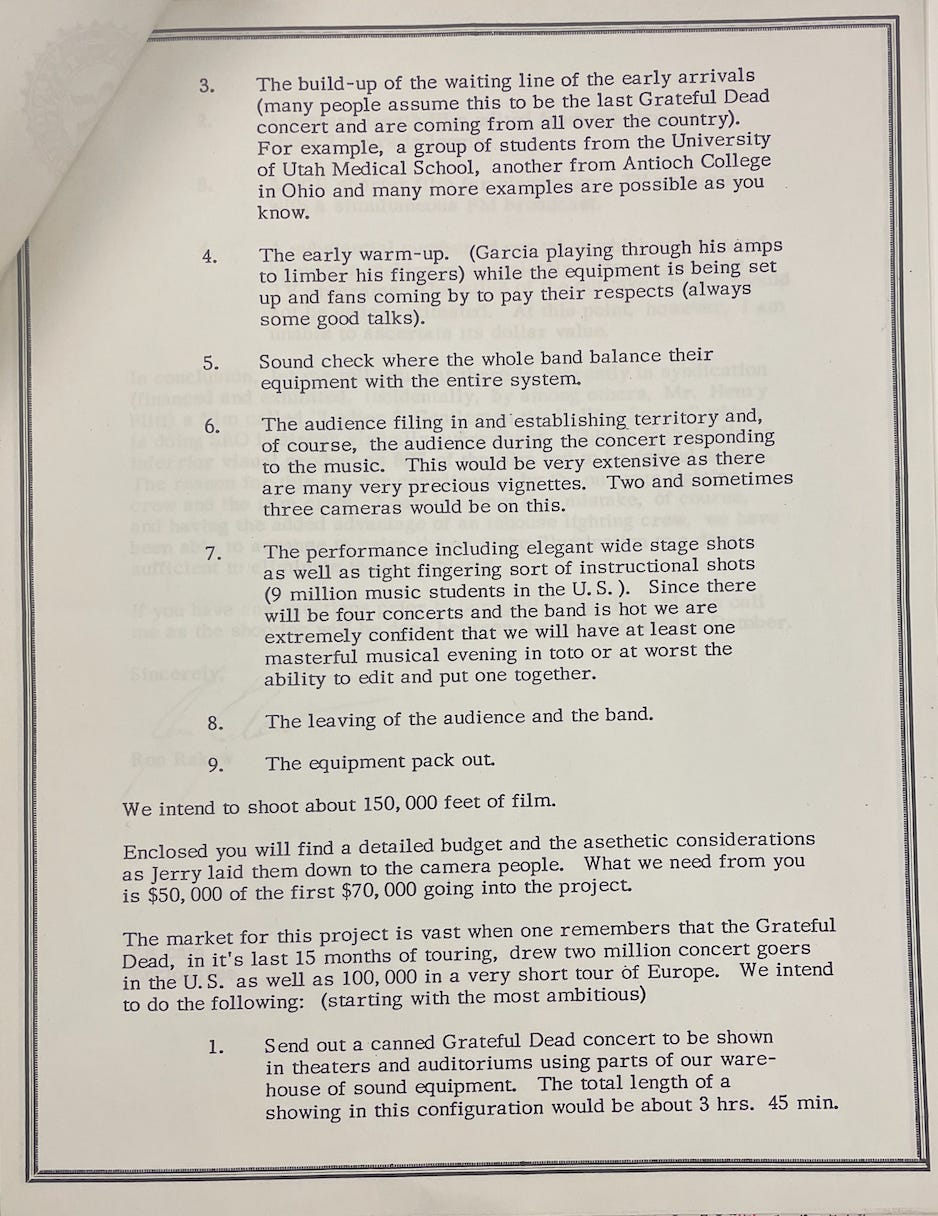
Figure 1, cont.: Page two
Rakow requested a loan of $50,000 and provided Dollard with a detailed breakdown of the estimated costs to produce the film. “The market for this project is vast,” he noted, especially “when one remembers that the Grateful Dead, in its last 15 months of touring, drew two million concert goers in the U.S. as well as 100,000 in a very short tour of Europe.” Rakow also detailed various projects that he and the band were planning with the “150,000 feet of film” (close to thirty hours) that they expected to shoot, including a nearly four-hour cut that would be presented as a “canned Grateful Dead concert to be shown in theaters and auditoriums using parts of our warehouse of sound equipment.” Continuing onto the third page of his letter (below), Rakow also described a two-hour cut for release as a feature-length film and a “still shorter film for viewing as a TV program with a simultaneous FM broadcast.” Finally, Rakow noted that a “substantial number of out takes…can be used by people making up completely different films or TV programs.” “The value of the out take library,” Rakow wrote, “should not be underestimated.”
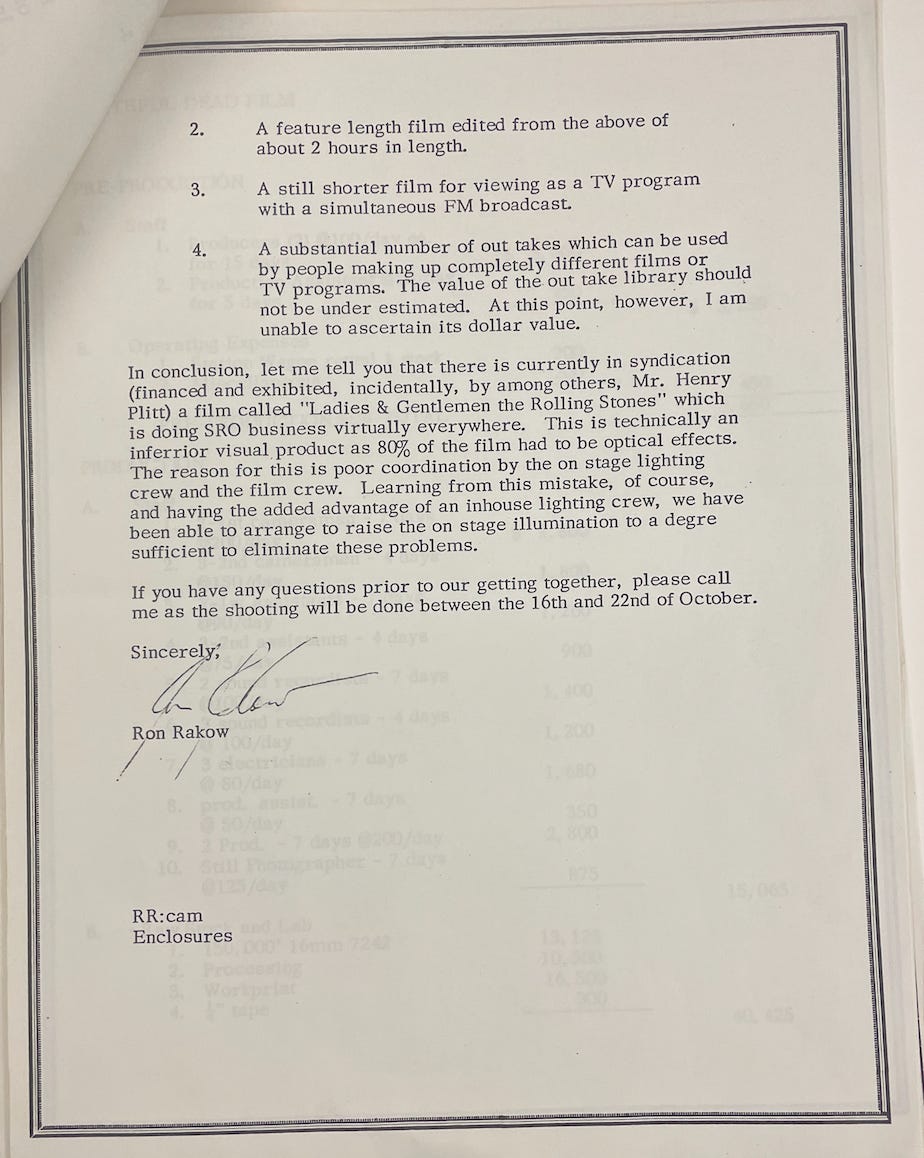
Figure 1, cont.: Page three
Along with a two-page budget estimate, Rakow provided Dollard with a brief statement attributed to Jerry Garcia regarding the film’s general “Aesthetics.” As seen below, Garcia was seeking “sensitive documentary guys mostly” as well as “one or two camera people who can do elegant commercial style work on [their] feet.” Within a short time, Garcia and Rakow had secured the services of Al Maysles and Kevin Keating, both of whom had worked on Gimme Shelter (1970) documenting the tragic events at Altamont in December 1969, and Don Lenzer who had filmed performances featured in Woodstock (1970). “The whole show,” Garcia’s statement continued, “should have a bit of ENTERTAINMENT feel but with a certain degree of documentary integrity of the event.” Finally, Garcia emphasized that the “filmakers [sic] and the film audience should always be aware that the Grateful Dead show experience is like a series of breaths—cosmic bellows: a sense of filling and emptying.”
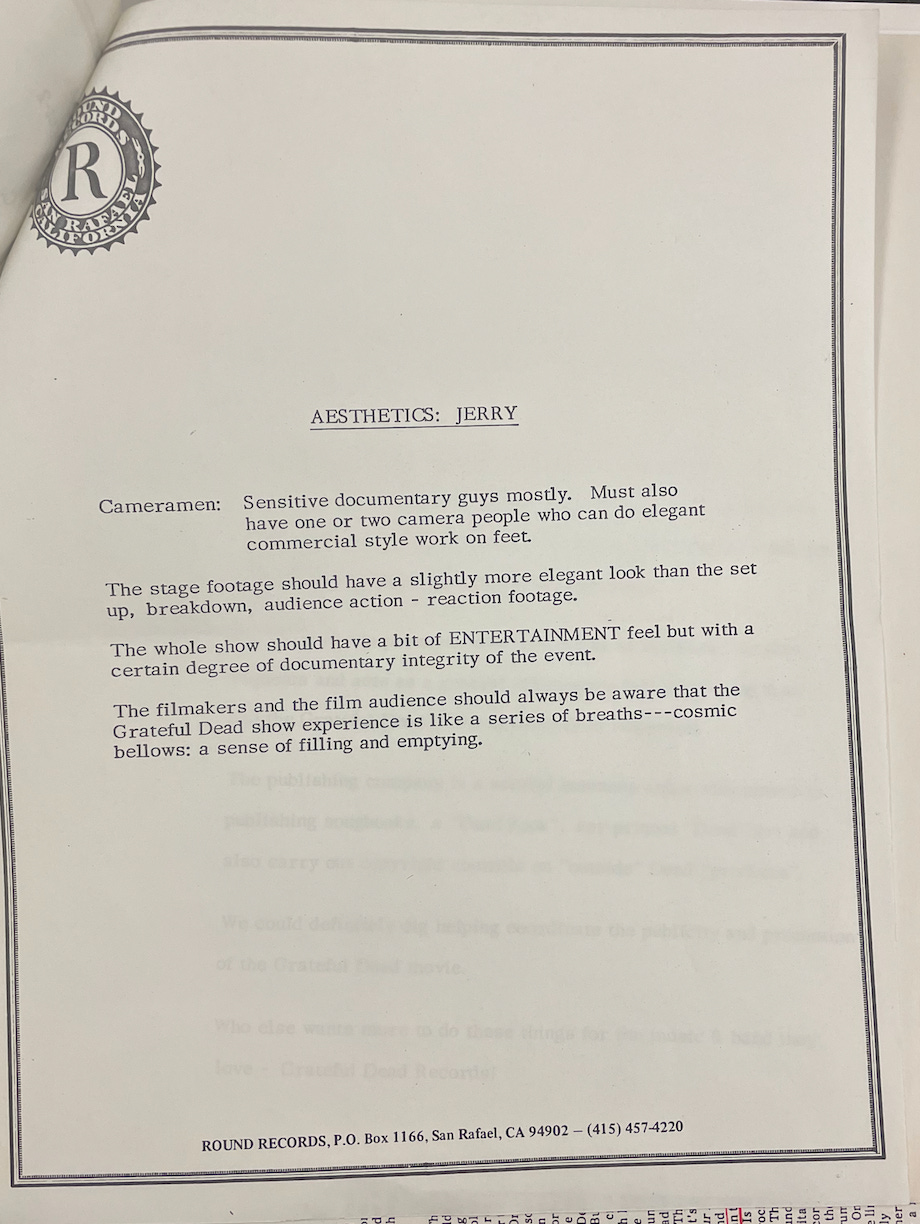
Figure 1, cont.: Page six (“Aesthetics: Jerry [Garcia])”
As Rakow sought to secure funding, other people within the Dead organization were attending to a variety of logistical, creative, and conceptual issues involving the band’s latest project. Given the many camera operators who would need to be accommodated on the stage of the Winterland, someone within the Dead organization created a stage plot detailing the locations of the band members and the various elements that comprised the group’s massive PA system, the “Wall of Sound.” The downstage area and PA system (including the location of Laurence “Ramrod” Shurtliff, a member of the band’s road crew) are represented at the bottom of the stage plot reproduced in Figure 2. Although it is not known when the plot was created, it is notable that an area of the stage had been reserved for Mickey Hart (“MH”), a member of the group who had not performed live with the Dead since February 1971, and who would rejoin the band for the final concert of the run (“The Last One”?) on October 20. Moving further upstage, the plot identifies Jerry Garcia (“JG”) and Phil Lesh (“PL”) on stage left and stage right, respectively. (In the concert footage that appears throughout The Grateful Dead Movie, however, Garcia and Lesh occupy the opposite sides of the stage than those identified on the plot.)
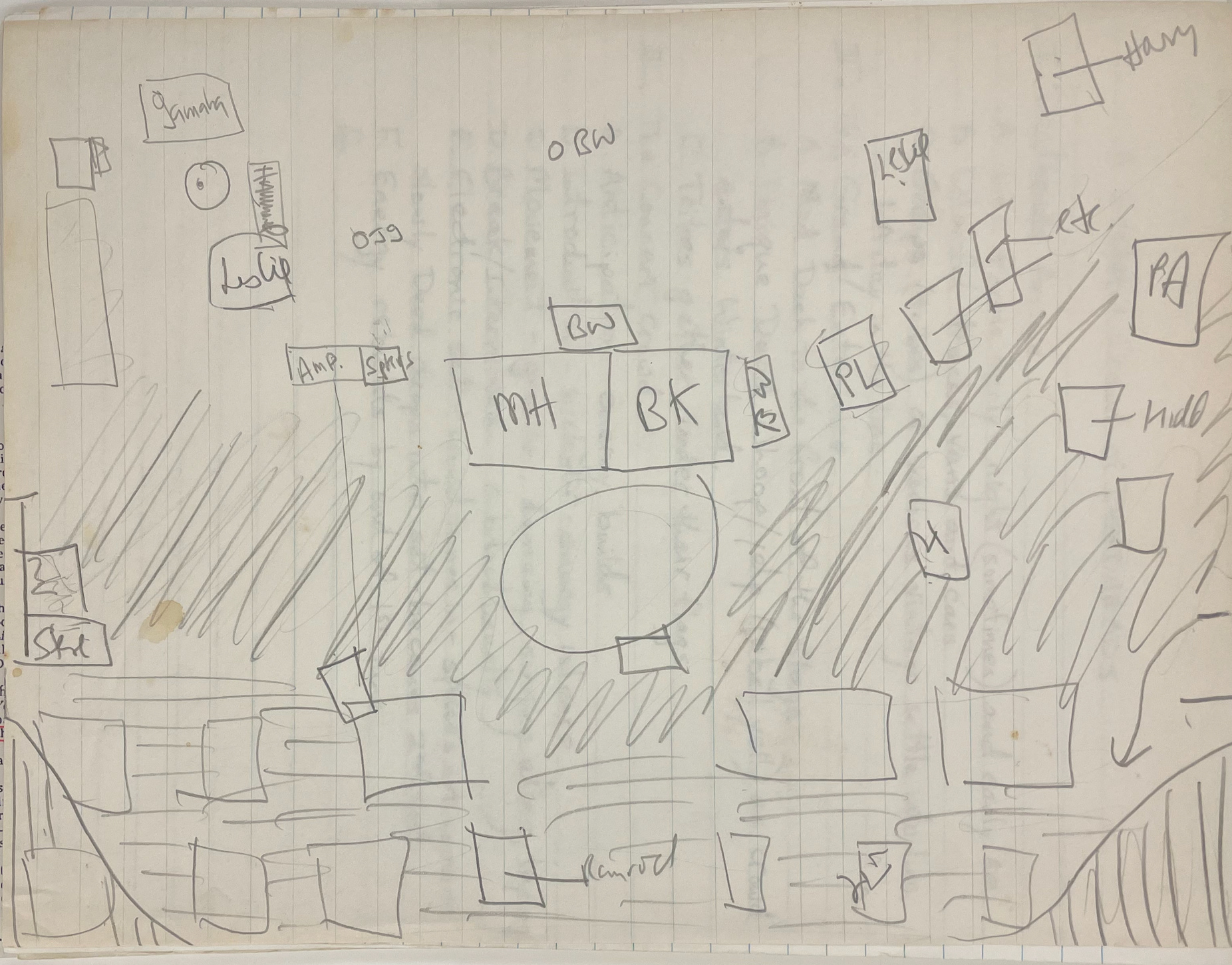
Figure 2: Stage plot for performances at Winterland Arena, San Francisco, October 16-20, 1974
Along with the stage plot, a page of notes detailing “A Grateful Crowd of DEADHEADS” provides a general outline for the film and may have been written by Steve Brown, a multiskilled and multitalented member of the Dead’s business organization. As seen in Figure 3, Brown developed a three-act design for the film that begins when the “Deadheads Arrive,” followed by the “Grand Enterance” [sic] into the Winterland, and continuing throughout the musical performances. Under the heading “The Concert Crowd,” Brown also described scenes of the audience as they listened to the “Electronic Set,” a segment of each concert during which bassist Phil Lesh and composer Ned Lagin improvised on synthesizers, a performance generally referred to as “Seastones.” While some members of the “crowd tunes in” to the performance, others, Brown wrote, space out.
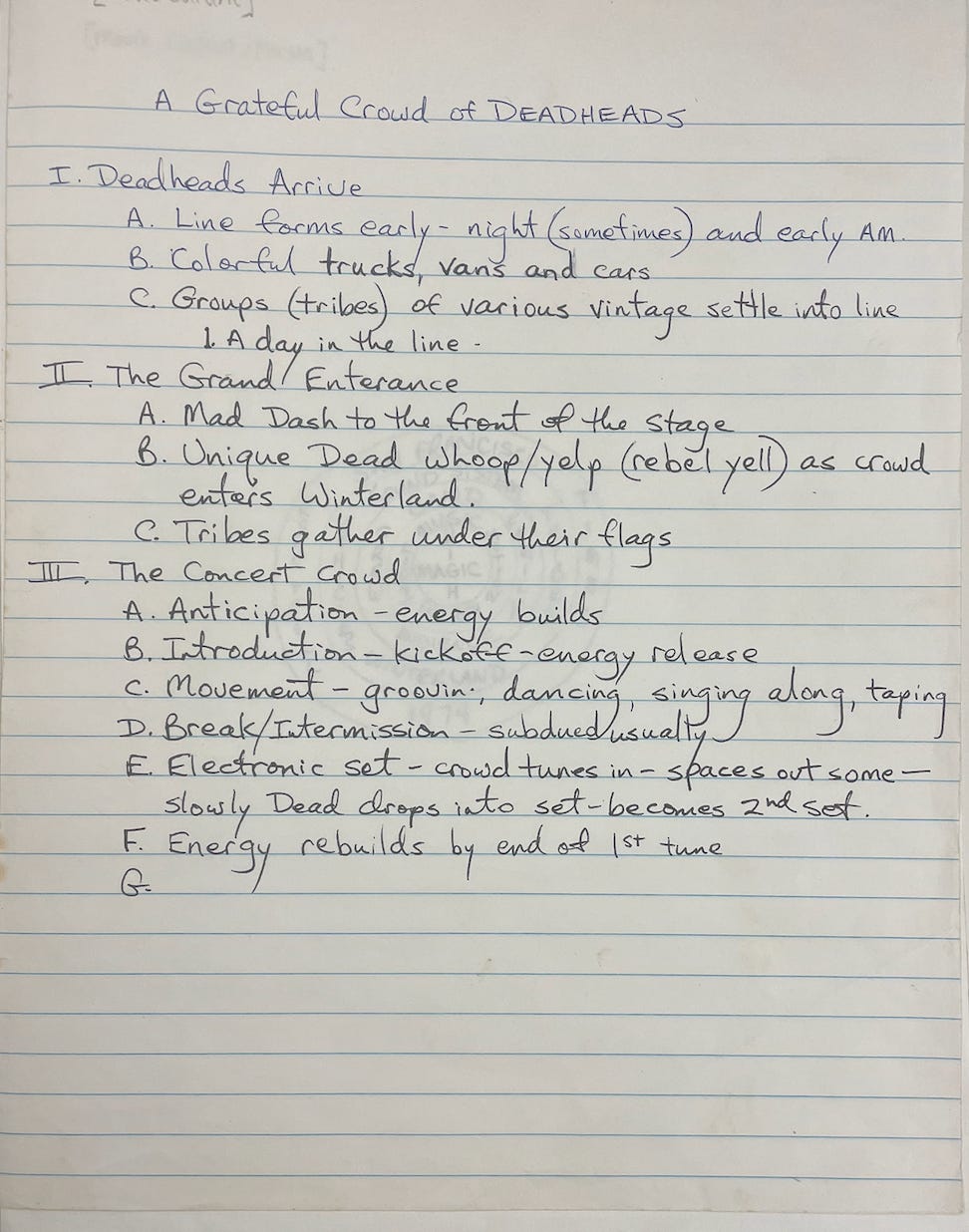
Figure 3: Provisional film outline (no date; written by Steve Brown?)
Elsewhere, Brown sketched an intriguing mandala-like design that vividly portrays particular themes and various ideas that would be used to guide and inform the artistic shape and creative design of the movie. As seen in Figure 4, Brown identified numerous people, places, and concepts that he arranged as part of five concentric circles. For instance, “Rock + Roll,” “San Francisco,” and “1974” appear alongside the “Times” in the outermost circle of his figure while the concepts of “Music,” “Motion,” “Energy,” and “Light” reside closer to the middle. At the center of the figure, the linked phrases “High Magic”/“Magic High” serve as the essential concepts around which the other circles orbit, representing the fundamental themes of the movie along with, perhaps, what Garcia more generally described as the “Grateful Dead show experience.”
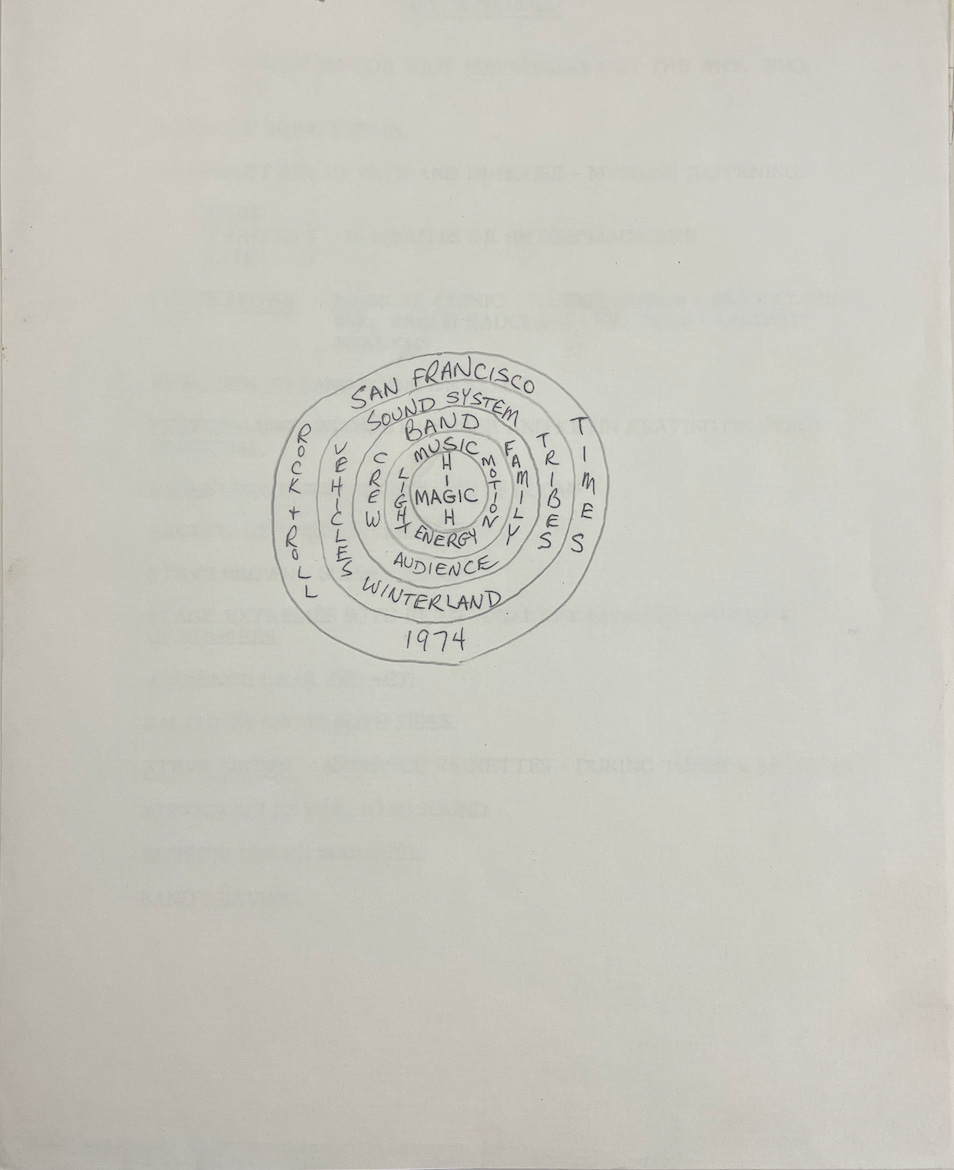
Figure 4: Figure depicting themes and concepts for proposed film (no date; created by Steve Brown?)
Ultimately, it would cost much more than $50,000 to produce The Grateful Dead Movie. As the project dragged on over the next two and half years, biographer Dennis McNally estimated that the Dead spent over $600,000 “at a time when, because of the [touring] hiatus, the band had no extra money.”[1] While Garcia continued to work on the film throughout 1976, the band fired Ron Rakow (who then promptly took $225,000 from the company), the Grateful Dead Record Company was dissolved, and the group signed a recording contract with Arista Records. By the summer of 1977, the band had returned to the road and were preparing to release their latest studio album, Terrapin Station. Even as the Dead were beginning to embark on another new journey in their musical career, The Grateful Dead Movie was finally released in June 1977 and provided fans and film audiences an opportunity to revisit some of the “high magic”/“magic high” the enveloped the group’s “farewell” concerts in October 1974.
See for yourself.
[1] Dennis McNally, A Long Strange Trip: The Inside History of the Grateful Dead (New York: Broadway Books, 2002), 499.
I followed the link last night and rewatched the Grateful Dead movie. When I last watched it on DVD sometime in the early 2000s one of the songs that stuck out most was "Lady With a Fan" and the animation that went with it. But it wasn't in the movie and a web search brought up no references. Do you know what it was that I saw?